Key takeaways
- Price per token is what a provider charges for each token, while cost per run is what one call to that model costs on your prompt.
- Cost per run depends on how much you send, how much the model writes back, how much it thinks, and pricing rules that differ by provider.
- A model with a lower price per token can cost more per run when it writes longer answers or thinks for longer.
- The reliable way to know is to run your real prompt and read the cost of each answer.
A model's price per token is a rate, not a bill. The cost of one run is the tokens you send plus the tokens the model writes and thinks, each at its own rate, plus any provider rules such as size limits, peak hours, or a fee per request. Run your real prompt to see it.
A rate does not tell you what your prompt costs
Providers publish a price per million input tokens and a price per million output tokens. That is the rate. The bill depends on how many tokens your prompt and the model's answer really use, and that changes with every prompt and every model.
| What goes into one run | Billed as | What makes it grow |
|---|---|---|
| Your prompt, system prompt, attached images, and document text | Input | Longer prompts, more files, a longer chat history |
| The answer | Output | A model that writes longer answers |
| Thinking before the answer | Output | A model that reasons for longer, or a higher reasoning effort |
| Provider rules | Varies | Input past a size limit, peak hours, a fee per request |
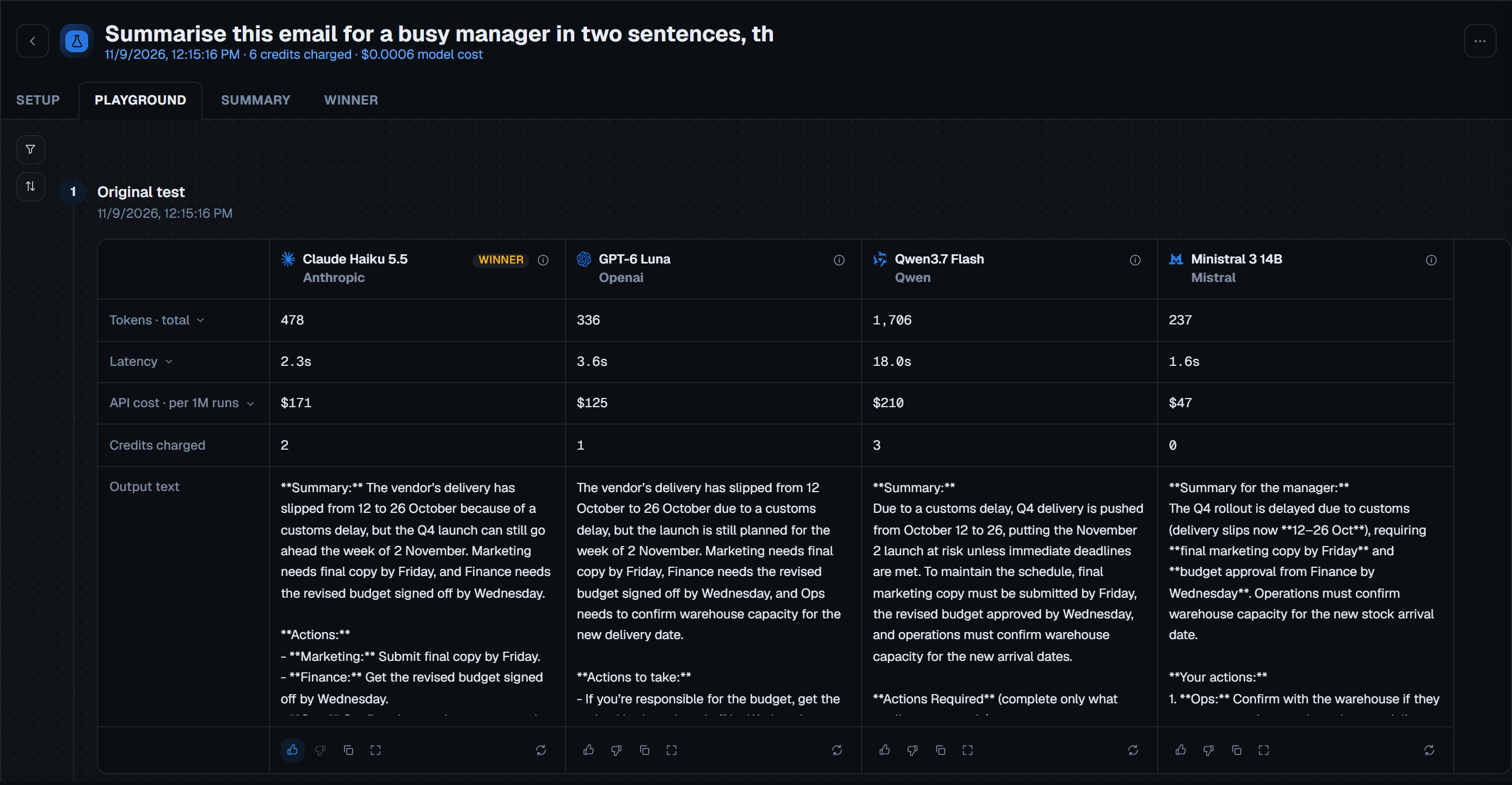
Everything you send is billed as input
Your prompt, your system prompt, any attached image or document text, and in a chat test the conversation so far are all input. A long system prompt is paid for on every run, not once.
The answer and the thinking are both billed as output
The answer is billed as output. Models that reason before they answer bill those thinking tokens as output too. Test AI models counts them in the cost of the answer, even when a provider reports them separately.
Some providers add rules on top of the rate
Some models charge a higher rate once the input passes a size limit. One provider in our catalog, DeepSeek, charges more during set hours of the day. Perplexity adds a fixed fee to each request. Test AI models prices each call with these rules, so the cost you see is the cost of that call.
A cheaper rate can still cost you more
This example is made up. Model A costs half as much per output token as model B, and on your prompt it writes an answer 3 times as long. Model A's output then costs one and a half times what model B's does.
Thinking works the same way. A model that thinks for a long time before a short answer can cost more than its rate suggests. The reverse also happens: a flagship model that answers in one tight line can cost less per run than its price per token would make you expect.
Chats cost more with every message
In a chat test, every new message re-sends the whole conversation to each model. Each message costs more than the one before. Test AI models tells you when a chat is getting long, and refuses a message that would make it too long to send.
Test AI models shows the cost before and after every run
- Before you run: the test shows "Needed to start", in credits. It is the worst case: every model writing the longest answer you allow, extra room for the models that keep thinking past that limit, and a 20% safety margin that is never charged.
- After you run: each answer shows what it really cost, in the provider's dollars next to the credits charged. Your balance moves once, when the run ends, by what the models really used.
- At your volume: the test page can show each model's API cost per 1M runs, so you can compare models at the scale you run them.
Three settings keep the cost of a run down
- Set Max tokens to the longest answer you need. It caps the answer and lowers "Needed to start".
- Try a lower reasoning effort on models that support it, and check that the answers still hold.
- Read the thinking heads-up. Before a run, Test AI models warns you when a model that thinks a lot may use up your Max tokens before it answers.
The catch: a lower Max tokens or reasoning effort can cut an answer short. Check the answers, ideally with a quality check, before you keep the cheaper settings.
Run your own test
Paste one of your real prompts, pick a few models with different rates, and compare the cost of each answer.
- 10k free credits
- No card
Marko
Questions
Why did a run use fewer credits than "Needed to start"?
"Needed to start" is the worst case plus a 20% safety margin. Your balance is charged for what the models really used, which is usually less.
Can a run cost more than "Needed to start"?
Sometimes. A few models, Grok and Qwen among them, can keep thinking past the answer limit you set. If that takes your balance below zero, you are told by notification and email.
Is the cost of a run always the same?
No. The same prompt can get a longer or shorter answer each time. A reliability check repeats a finished test to show how much the cost varies.

Runs Eterna Creative and built Test AI models after repeated multi-provider LLM integration work for client products.
About the team